National Tower Blocks Directory 1987
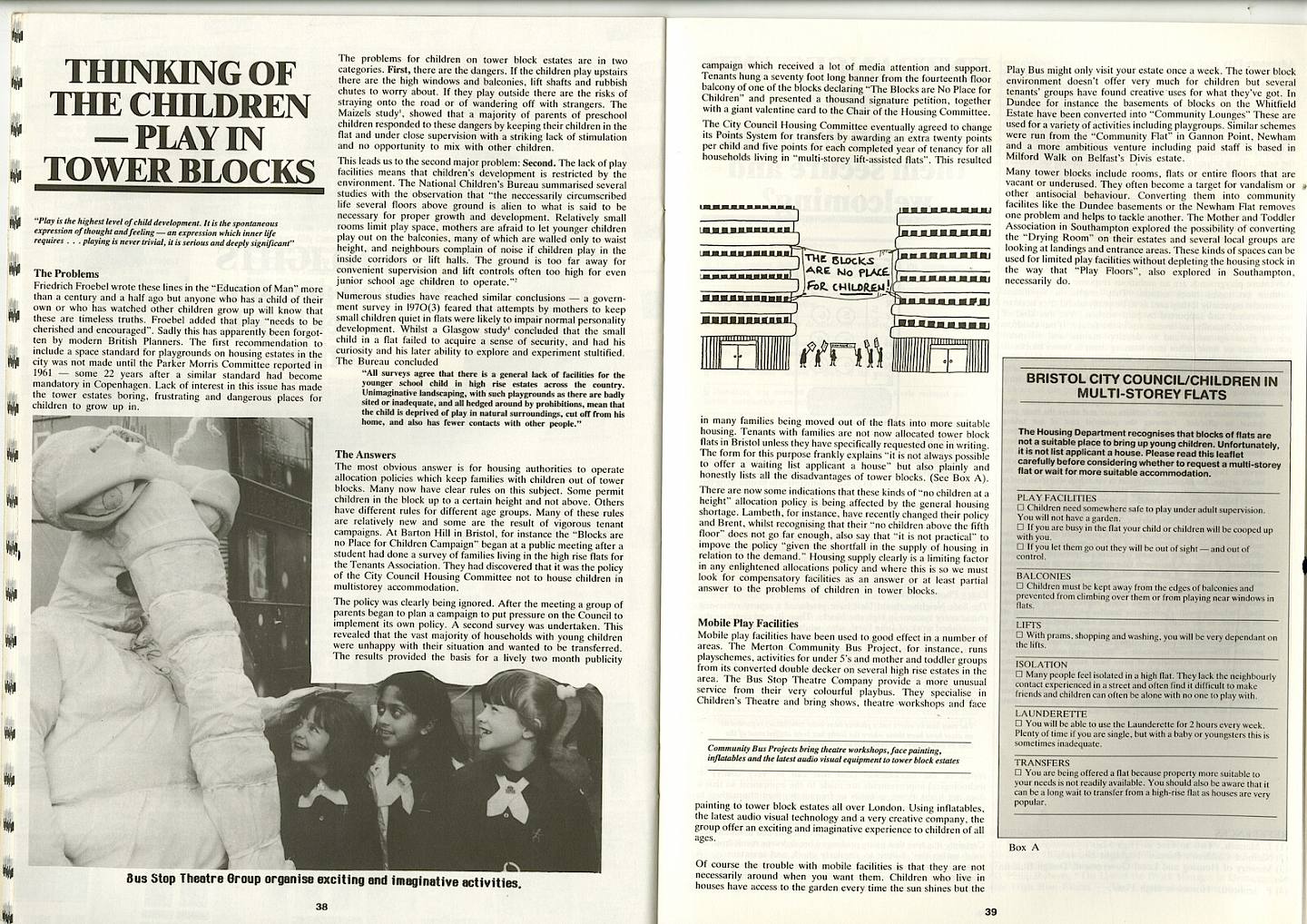
THINKING OF THE CHILDREN — PLAY IN TOWER BLOCKS
“Play is the highest level of child development. It is the spontaneous expression of thought and feeling — an expression which inner life requires . . . playing is never trivial, it is serious and deeply significant”
The Problems
Friedrich Froebel wrote these lines in the “Education of Man” more than a century and a half ago but anyone who has a child of their own or who has watched other children grow up will know that these are timeless truths. Froebel added that play “needs to be cherished and encouraged”. Sadly this has apparently been forgotten by modern British Planners. The first recommendation to include a space standard for playgrounds on housing estates in the city was not made until the Parker Morris Committee reported in 1961 — some 22 years after a similar standard had become mandatory in Copenhagen. Lack of interest in this issue has made the tower estates boring, frustrating and dangerous places for children to grow up in.
[caption: Bus Stop Theatre Group organise exciting and imaginative activities.]
The problems for children on tower block estates are in two categories. First, there are the dangers. If the children play upstairs there are the high windows and balconies, lift shafts and rubbish chutes to worry about. If they play outside there are the risks of straying onto the road or of wandering off with strangers. The Maizels study¹, showed that a majority of parents of preschool children responded to these dangers by keeping their children in the flat and under close supervision with a striking lack of stimulation and no opportunity to mix with other children.
This leads us to the second major problem: Second. The lack of play facilities means that children's development is restricted by the environment. The National Children's Bureau summarised several studies with the observation that “the necessarily circumscribed life several floors above ground is alien to what is said to be necessary for proper growth and development. Relatively small rooms limit play space, mothers are afraid to let younger children play out on the balconies, many of which are walled only to waist height, and neighbours complain of noise if children play in the inside corridors or lift halls. The ground is too far away for convenient supervision and lift controls often too high for even junior school age children to operate.”²
Numerous studies have reached similar conclusions — a government survey in 1970(3) feared that attempts by mothers to keep small children quiet in flats were likely to impair normal personality development. Whilst a Glasgow study¹ concluded that the small child in a flat failed to acquire a sense of security, and had his curiosity and his later ability to explore and experiment stultified. The Bureau concluded
“All surveys agree that there is a general lack of facilities for the younger school child in high rise estates across the country. Unimaginative landscaping, with such playgrounds as there are badly sited or inadequate, and all hedged around by prohibitions, mean that the child is deprived of play in natural surroundings, cut off from his home, and also has fewer contacts with other people.”
The Answers
The most obvious answer is for housing authorities to operate allocation policies which keep families with children out of tower blocks. Many now have clear rules on this subject. Some permit children in the block up to a certain height and not above. Others have different rules for different age groups. Many of these rules are relatively new and some are the result of vigorous tenant campaigns. At Barton Hill in Bristol, for instance the “Blocks are no Place for Children Campaign” began at a public meeting after a student had done a survey of families living in the high rise flats for the Tenants Association. They had discovered that it was the policy of the City Council Housing Committee not to house children in multistorey accommodation.
The policy was clearly being ignored. After the meeting a group of parents began to plan a campaign to put pressure on the Council to implement its own policy. A second survey was undertaken. This revealed that the vast majority of households with young children were unhappy with their situation and wanted to be transferred. The results provided the basis for a lively two month publicity
campaign which received a lot of media attention and support. Tenants hung a seventy foot long banner from the fourteenth floor balcony of one of the blocks declaring “The Blocks are No Place for Children” and presented a thousand signature petition, together with a giant valentine card to the Chair of the Housing Committee.
The City Council Housing Committee eventually agreed to change its Points System for transfers by awarding an extra twenty points per child and five points for completed year of tenancy for all households living in “multi-storey lift-assisted flats”. This resulted
[caption: THE BLOCKS ARE NO PLACE FOR CHILDREN!]
in many families being moved out of the flats into more suitable housing. Tenants with families are not now allocated tower block flats in Bristol unless they have specifically requested one in writing. The form for this purpose frankly explains “it is not always possible to offer a waiting list applicant a house” but also plainly and honestly lists all the disadvantages of tower blocks. (See Box A).
There are now some indications that these kinds of “no children at a height” allocation policy is being affected by the general housing shortage. Lambeth, for instance, have recently changed their policy and Brent, whilst recognising that their “no children above the fifth floor” does not go far enough, also say that “it is not practical” to improve the policy “given the shortfall in the supply of housing in relation to the demand.” Housing supply clearly is a limiting factor in any enlightened allocations policy and where this is so we must look for compensatory facilities as an answer or at least partial answer to the problems of children in tower blocks.
Mobile Play Facilities
Mobile play facilities have been used to good effect in a number of areas. The Merton Community Bus Project, for instance, runs playschemes, activities for under 5's and mother and toddler groups from its converted double decker on several high rise estates in the area. The Bus Stop Theatre Company provide a more unusual service from their very colourful playbus. They specialise in Children's Theatre and bring shows, theatre workshops and face
[caption: Community Bus Projects bring theatre workshops, face painting, inflatables and the latest audio visual equipment to tower block estates]
painting to tower block estates all over London. Using inflatables, the latest audio visual technology and a very creative company, the group offer an exciting and imaginative experience to children of all ages.
Of course the trouble with mobile facilities is that they are not necessarily around when you want them. Children who live in houses have access to the garden every time the sun shines but the
Play Bus might only visit your estate once a week. The tower block environment doesn't offer very much for children but several tenants' groups have found creative uses for what they've got. In Dundee for instance the basements of blocks on the Whitfield Estate have been converted into “Community Lounges” These are used for a variety of activities including playgroups. Similar schemes were run from the “Community Flat” in Gannon Point, Newham and a more ambitious venture including paid staff is based in Milford Walk on Belfast's Divis estate.
Many tower blocks include rooms, flats or entire floors that are vacant or underused. They often become a target for vandalism or other antisocial behaviour. Converting them into community facilities like the Dundee basements or the Newham Flat removes one problem and helps to tackle another. The Mother and Toddler Association in Southampton explored the possibility of converting the “Drying Room” on their estates and several local groups are looking at landings and entrance areas. These kinds of spaces can be used for limited play facilities without depleting the housing stock in the way that “Play Floors”, also explored in Southampton, necessarily do.
BRISTOL CITY COUNCIL/CHILDREN IN MULTI-STOREY FLATS
The Housing Department recognises that blocks of flats are not a suitable place to bring up young children. Unfortunately, it is not list applicant a house. Please read this leaflet carefully before considering whether to request a multi-storey flat or wait for more suitable accommodation.
PLAY FACILITIES
☐ Children need somewhere safe to play under adult supervision.
You will not have a garden.
☐ If you are busy in the flat your child or children will be cooped up with you.
☐ If you let them go out they will be out of sight — and out of control.
BALCONIES
☐ Children must be kept away from the edges of balconies and prevented from climbing over them or from playing near windows in flats.
LIFTS
☐ With prams, shopping and washing, you will be very dependant on the lifts.
ISOLATION
☐ Many people feel isolated in a high flat. They lack the neighbourly contact experienced in a street and often find it difficult to make friends and children can often be alone with no one to play with.
LAUNDERETTE
☐ You will be able to use the Launderette for 2 hours every week.
Plenty of time if you are single, but with a baby or youngsters this is sometimes inadequate.
TRANSFERS
☐ You are being offered a flat because property more suitable to your needs is not readily available. You should also be aware that it can be a long wait to transfer from a high-rise flat as houses are very popular.
Box A