National Tower Blocks Directory 1987
INTRODUCTION TO THE NETWORK
THE NATIONAL TOWER BLOCKS NETWORK is composed of individuals and organisations concerned to improve the quality of life in Britain's tower block homes. The Network was established in 1984 to gather and share information about the social and structural problems of tower blocks and to promote solutions to these problems. It is a Community Links project.
COMMUNITY LINKS is an independent social action centre in Newham, East London. It was formed by local volunteers in 1977 to work practically on the problems that concern them. Our work with children is principally aimed at those who are 'at risk' either as the result of their own behaviour or situation or that of their family. We provide constructive activities for all age groups including After School Clubs, a Toy Library, Holiday Playschemes and a range of unique groups for young children with special difficulties and for teenagers who've been in trouble. Our work with adults includes a wide variety of advice sessions, most run by trained volunteers. From them many very active self help groups have developed. These include the Handicapped Helpline, the Pensioners Club, a campaign for the Single Homeless, a Mother and Baby group, and the Asian Women's group. Our national role has developed from the success of these local activities. Both the National Tower Blocks Network and Action Match (which promotes the commercial sponsorship of community action) seek to effectively share local experiences and thus inform policy and improve practise at a national level.
[logo: Community LINKS National Tower Blocks Network 81 High St. South London E6 4EJ Telephone: 01-472 6652]
Design & artwork Community Links
Typeset & printed by Redesign 01-533 2631
British Library Cataloguing in Publication Data
National Tower Blocks Directory.
1. High-rise apartment buildings — Great Britain
I. Clarke, Frances
307'.3362 HD7287.6.G7
ISBN 0-9512357-0-2
CONTENTS
INTRODUCTION TO THE NETWORK
GUIDE TO USING THIS DIRECTORY 1
DIRECTORY ENTRIES 2
GLOSSARY OF STRUCTURAL TERMS 28
GEOGRAPHICAL LISTING 29
ISSUE LISTING 31
HIGHLIGHTS:
THINKING OF THE CHILDREN — PLAY IN TOWER BLOCKS 38
ENTRANCES AND EXITS: HOW CAN WE MAKE THEM SECURE AND WELCOMING? 40
"WE CAN MANAGE!" — KENNISHEAD TENANT MANAGEMENT CO-OPERATIVE 42
FIGHTING THE COLD 44
TOWER BLOCK HOMES AND THE SINGLE PERSON 45
"DIVIS — THE WORST HOUSING IN EUROPE" 46
TACKLING RACISM 48
THE 'DRAGON GARDEN' — AN ENVIRONMENTAL IMPROVEMENT PROGRAMME 52
BEATING THE COCKROACHES 53
ASBESTOS IN TOWER BLOCKS 54
BUILDING ON THE ASSETS; HOW THE SCOTTISH SPECIAL HOUSING ASSOCIATION MAKE BEST USE OF THEIR MULTI-STOREYS 56
"LET'S DO SOMETHING!" — COMMUNITY ACTIVITIES ON TOWER BLOCK ESTATES 57
BUILDING BRIDGES — THE RELATIONSHIP BETWEEN COUNCIL AND TENANTS 58
THE DEMOLITION OF RONAN POINT 60
OUR ART — THE WORK OF STEPHEN WILLATS 62
USERS AS MANAGERS — COMMUNITY SOCIAL WORK ON THE HYDE PARK ESTATE 64
The National Tower Blocks Network has been funded by the Department of the Environment, the Calouste Gulbenkian Foundation, the Abel Trust and Shelter. We gratefully acknowledge this support.
GUIDE TO USING THIS DIRECTORY
The National Tower Blocks Directory has been compiled by The National Tower Blocks Network.
This Directory contains information from local authorities who own tower blocks, from local and national tenants and community groups who represent tower block tenants and from other organisations and individuals who have responded in a variety of ways to tower block problems.
Councils, organisations and individuals were asked to describe in their own words the type of tower blocks they owned, lived in or worked in; what problems they had identified; what plans they had; and what actions they had taken.
The Directory is divided into two sections: the first includes lists of Councils, organisations and individuals who responded to the survey. The second is devoted to more detailed examples of the work of some of the respondents.
The first section includes an alphabetical list of local authorities, tenants and community groups, national groups and individuals. Each entry includes contact name, address and telephone number plus a brief description of the nature of involvement with tower block issues. There is also a summary, in code form, of the particular tower block problem which the respondent has tackled. The information included here has all been provided by the individual respondents.
The same respondents have then been arranged in a geographical list which is divided into regions. Under each regional heading there is a list of every Council, organisation and individual included in the Directory. There is also a further list of national organisations who serve all the regions.
The first section concludes with a "problems and issues list". This is divided into the categories included in the questionnaire. Respondents who have tackled particular problems eg. Asbestos, are listed under that heading.
These three lists are intended to enable the reader to identify respondents who have tackled particular problems, and to find out about other councils, organisations and individuals in their own region.
The second section of The Directory highlights particular problems and examines some of the responses we have come across throughout the country. Most are, we feel, examples of good practice. Some are examples of what not to do! Both are included to help the reader tackle the problems of their estate armed with some knowledge about what has and has not worked elsewhere.
Examples of the questionnaires sent to councils, tenants' and community groups and individuals.
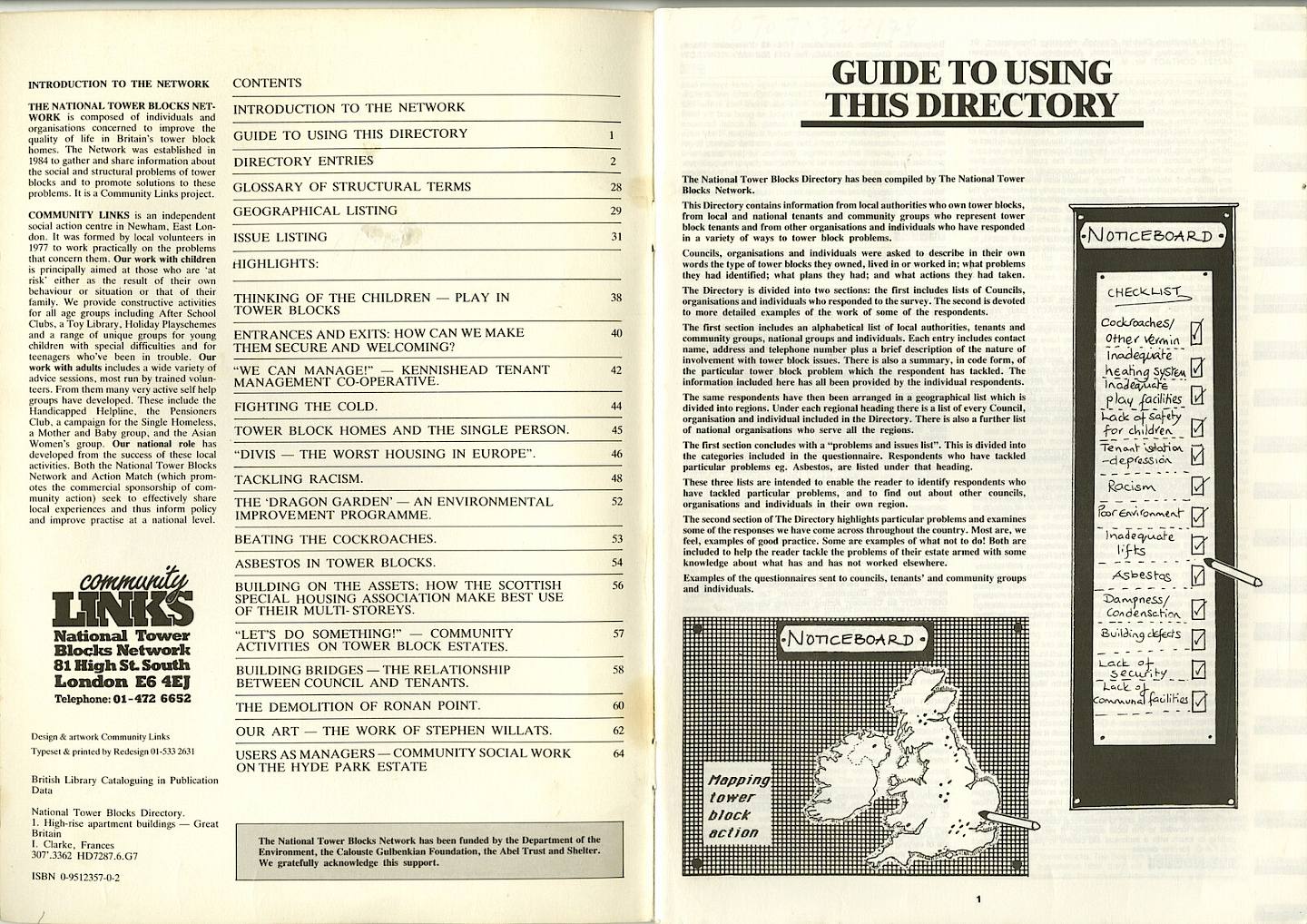
[caption: NOTICEBOARD
CHECKLIST
Cockroaches [check]
Other vermin [check]
Inadequate heating system [check]
Inadequate play facilities [check]
Lack of safety for children [check]
Tenant isolation -depression [check]
Racism [check]
Poor environment [check]
Inadequate lifts [check]
Asbestos [check]
Dampness/Condensation [check]
Building defects [check]
Lack of security [check]
Lack of communal facilities [check]]
[caption: NOTICEBOARD
Mapping tower block action]