The View, Winter 1990/1
PROFILE ON
FIRE SAFETY
This issue the View is featuring a special
profile on fire safety in Britain's Tower
Blocks, following the recent publication
of a report by the National Tower Blocks
Network. The report highlights the ap-
palling state of fire safety in many of our
tower blocks.
Structural defects, shoddy maintenance
and cuts in fire-testing have put many of
Britain's tower blocks in breach of regula-
tions and below the standards of bed and
breakfast accommodation. In the seven
tower blocks surveyed and in reports from
over 30 tenants associations a similar
picture emerges of the lack of fire safety
in our tower blocks.
Gas leaks and broken doors
Sporle Court, in the London Borough of
Wandsworth, has a piped gas supply. In
the event of a leak the gas had no way to
escape except into the corridor. Several
questions arise in relation to gas being
used in the block. Is the construction of
Sporle Court capable of withstanding an
explosion of 5psi as relevant legislation
demands?
Kedge House, in the London Borough of
Tower Hamlets, is of large panel con-
struction, and the structure is known to be
prone to gaps. BSCP CP3: Chap IV
(1962) requires each tower block flat to be
able to withstand a fire for an hour, before
spreading to other flats, thereby allowing
the fire to be extinguished. The gaps
between flats deny tenants this one hour
separation.
In all seven blocks surveyed the means of
escape in the case of fire are inadequate.
A number of fire doors, glazed panels and
rubbish chute covers are broken. In
Knighthead Point, London Borough of
Tower Hamlets, some of the doors have
been missing for four years. In Robert
Shaw House and Spring, in Sheffield, the
material used to line the ceilings of the
escape stairwells are flammable. In a
recent move the London Fire and Civil
Defence Authority have ordered all Fire
Services in London to carry out checks on
the surface finishes in all the tower blocks
in their area.
Fire safety recommendations
This is just one demand, our list of recom-
mendations could have gone on for pages
but we have focussed on five:
1. Fire Certification, allowing standards
of safety to be regularly checked and re-
pairs to be mandatory.
2. Regular fire drills.
3. Smoke Alarms fitted in every tower
block in the country.
4. Internal gas supplies to be removed
from all large panel system blocks.
5. A log book to be kept in every tower
block to record inspections, repairs and
maintenance.
They are not impossible and they are es-
sential. NTBN has discussed the national
implications of the lack of fire safety with
fire officers. This has raised further seri-
ous questions. One, in particular, is the
decision by the London Fire Brigade in
April 1990 to cease carrying out annual
'wet tests' on dry riser mains in tower
blocks. This inspection involved a practi-
cal test of the main, using a fire engine to
create the appropriate pressure which
was measured on the roof. This test
ensured that water could be pumped to
every floor in a fire. We have been
informed that the testing was stopped as
a result of spending restrictions imposed
on the London Fire Service.
Firefighters lives at risk
The withdrawal of this service effectively
means that the standard of inspection
and maintenance of essential fire fighting
equipment is lower in the London area
now than it was in Merry Hill Court at the
time of the fire. In that fire the lives of fire
fighters were seriously at risk due to in-
adequate and broken fire fighting equip-
ment.
Fire Brigade Union concerned
The Fire Brigade Union are as concerned
as NTBN about the fire risks in Britain's
tower blocks. In supporting our recom-
mendation for a fire certification cam-
paign the Fire Brigade Union quote from
the Fire Precautions Act 1971. This Act
gives power to a fire authority to make fire
certificates compulsory in certain
premises, including tower block flats and
maisonettes. The relevant section of the
Fire Precaution Act of 1971 has never
been enacted. Why?
What to do next?
The National Tower Block Network is
continuing to campaign on the issue of
fire safety. Let us know about the stan-
dard of fire safety in your blocks. Contact
your local fire service to ask what checks
they carry out. Raise the issue of smoke
alarms at the Housing Department. Then
let the NTBN know because all the infor-
mation will be used to back up the de-
mands for our recommendations to be-
come law.
BELFAST TENANTS' LOBBY ON FIRE SAFETY
The Tenants' Lobby Group
in Belfast have carried out
their own spot check on fire
safety in tower blocks in
Greater Belfast. Using the
guidelines provided by the
NTBN, the Group were
shocked to find that smoke
filters up from lower floors
due to gaps in the structure
and many fire doors don't
close. Their findings were
similar to those found in
other blocks across the
country.
The Tenants' Lobby Group
took their findings to the local
Sunday News, with the
chairperson, William Pol-
lock, calling for the North-
ern Ireland Housing Execu-
tive to; “urgently inspect all
multi-story blocks and com-
munal access blocks to
make sure they meet health
and fire safety standards of
the highest quality”. The
Housing Executive have
called the tenants' claims
'spurious', and that fire
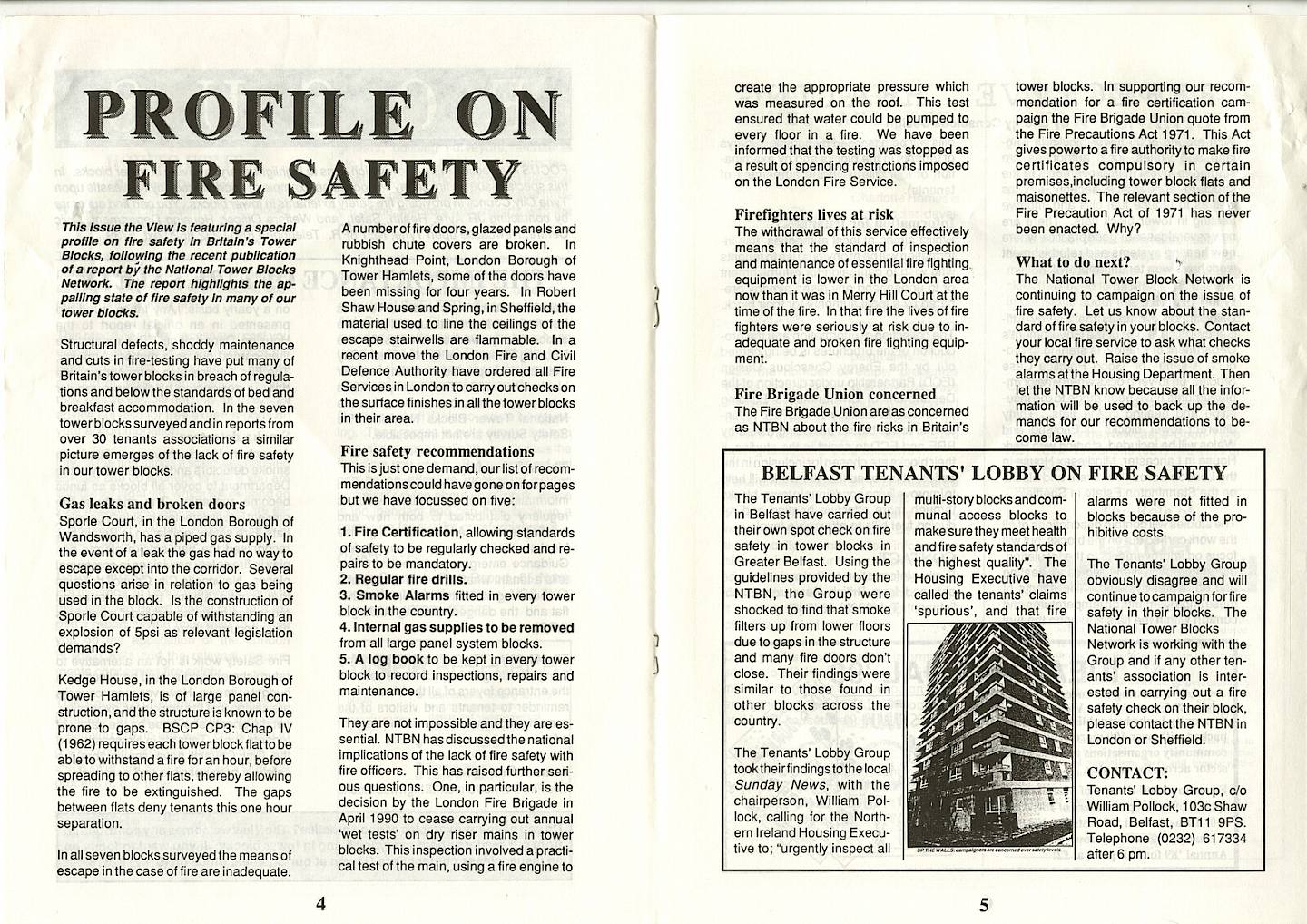
[caption: UP THE WALLS: campaigners are concerned over safety levels]
alarms were not fitted in
blocks because of the pro-
hibitive costs.
The Tenants' Lobby Group
obviously disagree and will
continue to campaign for fire
safety in their blocks. The
National Tower Blocks
Network is working with the
Group and if any other ten-
ants' association is inter-
ested in carrying out a fire
safety check on their block,
please contact the NTBN in
London or Sheffield.
CONTACT:
Tenants' Lobby Group, c/o
William Pollock, 103c Shaw
Road, Belfast, BT11 9PS.
Telephone (0232) 617334
after 6 pm.