The View, Winter 1991/2
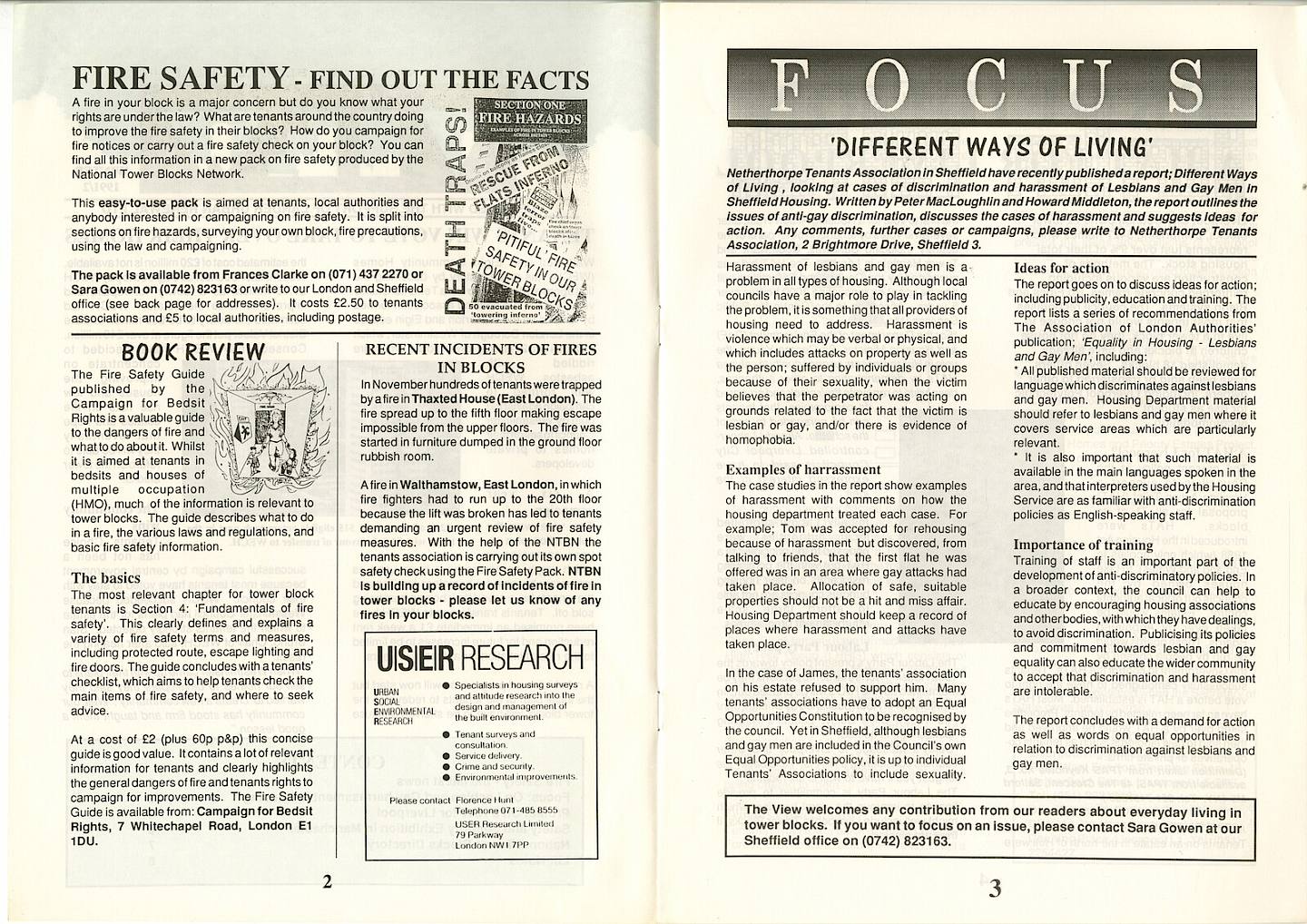
FIRE SAFETY - FIND OUT THE FACTS
A fire in your block is a major concern but do you know what your
rights are under the law? What are tenants around the country doing
to improve the fire safety in their blocks? How do you campaign for
fire notices or carry out a fire safety check on your block? You can
find all this information in a new pack on fire safety produced by the
National Tower Blocks Network.
This easy-to-use pack is aimed at tenants, local authorities and
anybody interested in or campaigning on fire safety. It is split into
sections on fire hazards, surveying your own block, fire precautions,
using the law and campaigning.
The pack is available from Frances Clarke on (071) 437 2270 or
Sara Gowen on (0742) 823163 or write to our London and Sheffield
office (see back page for addresses). It costs £2.50 to tenants
associations and £5 to local authorities, including postage.
[caption: SECTION ONE
FIRE HAZARDS
EXAMPLES OF FIRE IN TOWER BLOCKS
ACROSS BRITAIN
RESCUE FROM
FLATS INFERNO
Blaze
traps
five...
Fire chief urges
check on tower
blocks after
death in blaze
'PITIFUL' FIRE
SAFETY IN OUR
TOWER BLOCKS
50 evacuated from
'towering inferno']
BOOK REVIEW
The Fire Safety Guide
published by the
Campaign for Bedsit
Rights is a valuable guide
to the dangers of fire and
what to do about it. Whilst
it is aimed at tenants in
bedsits and houses of
multiple occupation
(HMO), much of the information is relevant to
tower blocks. The guide describes what to do
in a fire, the various laws and regulations, and
basic fire safety information.
The basics
The most relevant chapter for tower block
tenants is Section 4: 'Fundamentals of fire
safety'. This clearly defines and explains a
variety of fire safety terms and measures,
including protected route, escape lighting and
fire doors. The guide concludes with a tenants'
checklist, which aims to help tenants check the
main items of fire safety, and where to seek
advice.
At a cost of £2 (plus 60p p&p) this concise
guide is good value. It contains a lot of relevant
information for tenants and clearly highlights
the general dangers of fire and tenants rights to
campaign for improvements. The Fire Safety
Guide is available from: Campaign for Bedsit
Rights, 7 Whitechapel Road, London E1
1DU.
RECENT INCIDENTS OF FIRES
IN BLOCKS
In November hundreds of tenants were trapped
by a fire in Thaxted House (East London). The
fire spread up to the fifth floor making escape
impossible from the upper floors. The fire was
started in furniture dumped in the ground floor
rubbish room.
A fire in Walthamstow, East London, in which
fire fighters had to run up to the 20th floor
because the lift was broken has led to tenants
demanding an urgent review of fire safety
measures. With the help of the NTBN the
tenants association is carrying out its own spot
safety check using the Fire Safety Pack. NTBN
is building up a record of incidents of fire in
tower blocks - please let us know of any
fires in your blocks.
UISIEIR RESEARCH
URBAN
SOCIAL
ENVIRONMENTAL
RESEARCH
● Specialists in housing surveys
and attitude research into the
design and management of
the built environment.
● Tenant surveys and
consultation.
● Service delivery.
● Crime and security.
● Environmental improvements.
Please contact Florence Hunt
Telephone 071-485 8555
USER Research Limited
79 Parkway
London NW1 7PP
F O C U S
'DIFFERENT WAYS OF LIVING'
Netherthorpe Tenants Association in Sheffield have recently published a report; Different Ways
of Living, looking at cases of discrimination and harassment of Lesbians and Gay Men in
Sheffield Housing. Written by Peter MacLoughlin and Howard Middleton, the report outlines the
issues of anti-gay discrimination, discusses the cases of harassment and suggests ideas for
action. Any comments, further cases or campaigns, please write to Netherthorpe Tenants
Association, 2 Brightmore Drive, Sheffield 3.
Harassment of lesbians and gay men is a
problem in all types of housing. Although local
councils have a major role to play in tackling
the problem, it is something that all providers of
housing need to address. Harassment is
violence which may be verbal or physical, and
which includes attacks on property as well as
the person; suffered by individuals or groups
because of their sexuality, when the victim
believes that the perpetrator was acting on
grounds related to the fact that the victim is
lesbian or gay, and/or there is evidence of
homophobia.
Examples of harrassment
The case studies in the report show examples
of harassment with comments on how the
housing department treated each case. For
example; Tom was accepted for rehousing
because of harassment but discovered, from
talking to friends, that the first flat he was
offered was in an area where gay attacks had
taken place. Allocation of safe, suitable
properties should not be a hit and miss affair.
Housing Department should keep a record of
places where harassment and attacks have
taken place.
In the case of James, the tenants' association
on his estate refused to support him. Many
tenants' associations have to adopt an Equal
Opportunities Constitution to be recognised by
the council. Yet in Sheffield, although lesbians
and gay men are included in the Council's own
Equal Opportunities policy, it is up to individual
Tenants' Associations to include sexuality.
Ideas for action
The report goes on to discuss ideas for action;
including publicity, education and training. The
report lists a series of recommendations from
The Association of London Authorities'
publication; 'Equality in Housing - Lesbians
and Gay Men', including:
* All published material should be reviewed for
language which discriminates against lesbians
and gay men. Housing Department material
should refer to lesbians and gay men where it
covers service areas which are particularly
relevant.
* It is also important that such material is
available in the main languages spoken in the
area, and that interpreters used by the Housing
Service are as familiar with anti-discrimination
policies as English-speaking staff.
Importance of training
Training of staff is an important part of the
development of anti-discriminatory policies. In
a broader context, the council can help to
educate by encouraging housing associations
and other bodies, with which they have dealings,
to avoid discrimination. Publicising its policies
and commitment towards lesbian and gay
equality can also educate the wider community
to accept that discrimination and harassment
are intolerable.
The report concludes with a demand for action
as well as words on equal opportunities in
relation to discrimination against lesbians and
gay men.
The View welcomes any contribution from our readers about everyday living in
tower blocks. If you want to focus on an issue, please contact Sara Gowen at our
Sheffield office on (0742) 823163.